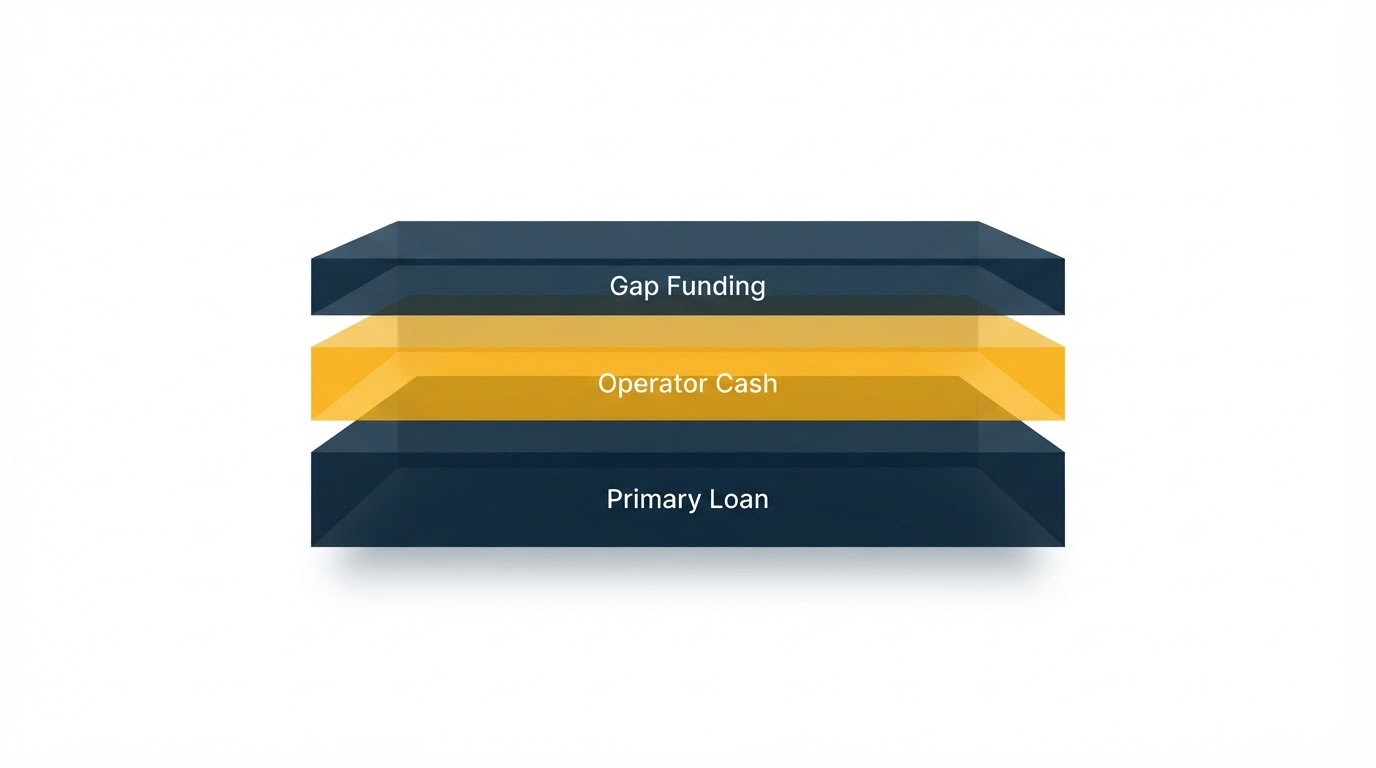
The Capital Stack, in Plain Terms
A fix-and-flip rarely runs on a single source of money. Most projects are put together in layers, what people call the capital stack. Each layer has a purpose, a cost, and a place in line. This is a general explanation of how the pieces fit, not advice for a specific deal.
The Primary Loan
At the base of the stack is usually a hard money loan that covers a portion of the purchase price and sometimes part of the rehab. The lender evaluates the deal and the property, not the borrower's W-2. Because it's the first money in and the first money secured, it sits in the senior position.
The Operator's Cash
Next comes the operator's own equity: the down payment, closing costs, and any portion of the rehab the primary lender won't cover. This is the cushion that keeps the stack from being over-leveraged.
The Gap
Here's where gap funding comes in. When the primary loan plus the operator's cash still don't fully cover the purchase, rehab, and carrying costs, a shortfall remains. Gap funding is short-term capital that bridges that difference. It typically sits in a junior position behind the primary lender.
What Gap Funding Usually Covers
Gap capital can be applied to several pieces of a project:
- The down payment: the portion of the purchase price the primary lender won't finance.
- Rehab costs: especially the part not funded by the primary loan's construction draw.
- Closing and holding costs: taxes, insurance, and interest while the property is being improved.
How to Talk About It Clearly
The clearest conversations about gap funding start with the numbers in front of both parties. A deal package should lay out the purchase price, rehab budget, after-repair value, timeline, and exit strategy. From there, it's straightforward to see where the gap is and what it would take to fill it.
Structure Matters
Gap funding is usually structured as debt (a loan with a negotiated return) or equity (a share of the project's profit). Each carries different risk and reward. Whatever the structure, it should be documented in writing and reviewed by your own attorney.
Risk Is Real
A junior position means the gap funder stands behind the primary lender if things go wrong. If a project underperforms or runs long, returns may be delayed or reduced. All real estate involves risk, and past performance doesn't guarantee future results.
One Tool in the Stack
Gap funding isn't the whole story. It's one layer that makes a deal come together. Understanding where it fits, what it covers, and how it's secured is the foundation for any clear conversation about it.